WARNING THERE ARE SOME SPOILERS IN HERE WHICH IS WEIRD FOR A MOVIE BASED ON A 2500 YEAR OLD POEM BUT ALSO, IT’S CHRISTOPHER NOLAN AND THERE ARE SOME ACTUAL SPOILERS.
My colleague at Gonzaga, Dave Oosterhuis, teaches a class on Rome in Film and he has a line that has become something of a mantra among students who have taken the course (it’s a delight when it shows up randomly in one of my classes!): Movies about Rome are never really about Rome. They’re about us.
This Odyssey isn’t really about Homer – it too is about us. I’ve seen people talking about if the “us” in question is specifically the United States or a broader “us,” and I’m not sure that I feel strongly either way (I would lean toward thinking that it’s primarily aimed at US audiences, though maybe that’s my Americentrism showing). I know that a lot of the things in Nolan’s movie aren’t in Homer, but I also think that’s the least interesting place for conversations about a work of classical reception to end. I love that this movie departed significantly from Homer while still being recognizably inspired by and in conversation with Homer. I love when classical reception takes risks and makes real choices with solid reasons behind those choices, and this indisputably does.
I’m going to get into a lot of the specifics below, but my overall opinion on this movie is that it’s a pretty good look at what the story of Odysseus’ homecoming from Troy means to us in this moment. The depictions of “the gods” (which is really just Athena) is really nuanced and I loved how the movie handled it. I really like the way that Calypso absorbs the story of the Lotus Eaters (and, in some ways, the Phaeacians). I’m conflicted about the near total erasure of sexual violence in this version, but I see why it was done (I’m also conflicted about the handling of Helen, something I know people have objected to with good cause, but I’ll get into that more below). There are moments that are a little silly or cringey (Antinous while Odysseus kills the suitors) and several individual performances that are amazing (John Leguizamo!!). I have some complicated thoughts about the complicated man that is Odysseus, and this movie was a more sympathetic depiction than I tend to read in Homer. More than anything though, I loved the way that the centrality of xenia (hospitality) is emphasized even more in this movie than it is in Homer, which is saying something, because xenia is all over Homer’s Odyssey. The ending Nolan writes for this story is a neater and happier one than Homer gives us, but it’s also one that takes place against a backdrop of a world coming to an end. What the Greeks did at Troy (and, one could argue, on their way home) broke the world and maybe it will be reborn one day, after the “Dark Ages,” but the shared values and basic bonds of community (framed as “the law of Zeus”) that sustained the world are gone. Homer’s Odyssey really marks the end of the age of heroes in the Greek mythological timeline, though it’s not always read/taught/understood that way when we look at it in a vacuum, and Nolan gives us a story that explains very clearly why this heroic age is ending (because of the dissolution of basic ethical norms). It’s a story for an audience standing at a precipice, watching a world fall apart in the absence of bonds that regulate how humans act to one another. If the rules that we all agreed on (in word, if not in deed)—that we should welcome in the stranger, feed the hungry, protect the innocent and save the lives we can, recognize human dignity—aren’t there anymore, what will hold the world together?
Some specifics!
Women:
No one would ever accuse Nolan of writing numerous complex female characters, and that is what it is. But I do think that there are a lot of noteworthy things in the depictions of female characters in this movie. I am also well aware that so many of my colleagues disagree with me here, but here goes!
- The backdrop for all of this conversation is that there’s almost no sexual violence in this movie. There are hints of violence and abuse, but the status and safety of the enslaved women on Ithaca are elided. Melantho snitches on Penelope’s weaving ruse, and we could certainly imagine that her motivation has to do with survival and her hope that by endearing herself with the leader of the suitors, Antinous, she will avoid the horrible fates that could await an enslaved woman in a house full of terrible men. There is no scene of Telemachus hanging the enslaved women though, and while Melantho is denied an escape from the room where the suitors are being slaughtered (Penelope says something like “your place is with them”), I don’t think she was killed along with them. Compared to Homer’s vicious and horrifying treatment of the enslaved women, Nolan’s version is far less violent and victim-blaming. Circe’s actions are framed and justified in terms of the violence that is inherently threatened by a group of men approaching a single woman, but we are not given any particular reason to think that Odysseus’ men were in fact planning to assault her. The other major place where I see sexual violence in Homer’s Odyssey is on Calypso’s island, which I will discuss more below, but the sexual violation is also minimized there. And somehow, shockingly, the only violence that the Greek soldiers do to women when they sack Troy is the same kind of slaughter that they do to the men (which, to be fair, is still a war crime). On the one hand, I appreciate that women’s bodies are not violated to show us something important about the men involved, a trope that I think is used far too often as a lazy plot device to show that a character is bad. That said, it does cast Odysseus in a different light that he doesn’t defeat Circe in a very sexually tinged, phallic way before spending a year sleeping with her and frolicking on her island. Similarly, it casts Telemachus in a different light that he doesn’t enact horrific violence against enslaved women at the end of the story. I think these changes are very effective for what Nolan wants to do with both characters, but I can also see why this would rub you the wrong way if you don’t think it’s true to these characters to present an Odysseus who is less manipulative and more sympathetic or a Telemachus who is just a little spider-guy who couldn’t commit a war crime if he tried.
- Helen: From what I’ve gleaned from the bits of responses I’ve seen on social media, this is the most woman whose treatment most bothered people. To be clear, her casting as a Black woman troubled a lot of people, but those people are racists and I’m not super concerned with them. It also bothered a lot of decent people that she’s been brutalized by Menelaus since the Sack of Troy and she has scars over half her face. I can’t very well say that I’m glad that other female characters aren’t brutalized and then be glad that Helen is (and the issue is complicated by the fact that the one woman who suffers visible violence in this movie is a Black woman), but I do think that what keeps Helen alive and safe in Homer (and the majority of Greek myth) is a) her beauty and b) the fact that she seems to be drugging her husband. There are accounts (e.g., Euripides’ Andromache) that may as well have inspired the line in Princess Bride about how “There’s a shortage of perfect breasts in this world. It would be a pity to damage yours.” She bares her perfect breasts and Menelaus can’t kill her. Not to put too fine a point on it, but we know that beauty or lack thereof doesn’t correlate to whether a woman is likely to be a victim of domestic violence and I do think that a man like Menelaus (especially as imagined for a modern audience by Jon Bernthal) would not be kind to Helen. In a story about the aftermath of war and the damage it does on so many fronts, I don’t think Helen being a victim of domestic violence is gratuitous. That said, would I have loved to see evidence that Helen is drugging her husband to keep him subdued and complacent so he can’t continue hurting her, maybe in a way that echoes the men Circe turned into animals? Shoot, I’d love for Clytemnestra to show up and see two Lupita Nyong’os go full Goodbye Earl on his ass.
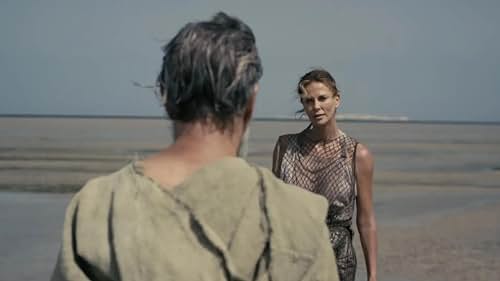
- Calypso: I really like what Nolan did by combining the Lotus Eaters and Calypso (whose name, after all, is related to the verb “to cover,” καλύπτω). This shift omits the fact that Homer’s Calypso is keeping a man on her island who does not want to be there, and she’s pretty clearly sleeping with him (something that we would immediately clock as problematic if the genders were reversed, but we often don’t with in the case of Calypso). There’s still some of that in Nolan’s version, but she started feeding him lotus to protect him and help him heal and she doesn’t require threats from the gods to let him go. That doesn’t remove the fact that Calypso is drugging Odysseus and, in essence, sexually assaulting him (leaving aside that no human can meaningfully consent to a god, given the power differential there). But this version does feel less violative, to me at least, than the version Homer gives us, in part because we’ve seen elsewhere that Odysseus may not want to go home and that his embrace of the lotus may be an attempt at escapism as much as anything else. Having Calypso take the place of the Phaeacians is also a very effective choice and I think it really works well.
The Ending:
- I would characterize this as a (relatively) happy ending, compared to Homer. It’s certainly simpler. Book 24 of the Odyssey is entirely about unsettling any thoughts the reader/listener might have had about this being a happy ending, as we have to stare in the face of all the ways what Odysseus does is not okay. The citizens of Ithaca are right to be super mad that all their sons and brothers just got murdered and the suitors are pretty reasonably like “wtf just happened??” when they show up in Hades. Athena forces people to live with that outcome, but without a deus (or dea) ex machina, I have to think that things end bloody. Or, bloodier.
- Particularly for a modern audience, the idea of a father who wants to protect his son from violence and its consequences is one that I think really works (and contributes to an overall picture of Odysseus that paints him in a much better light than Homer does). We really see over and over how much Telemachus cannot fight and cannot command the respect of the other, older men in his palace. He also doesn’t seem particularly clever, in the Odyssean mode. Rather than being disappointed in a son who is none of the things that his father is, Odysseus protects his son and takes on all of the blood guilt so that his son does not have to bear any of it. We see so many versions of stories about fathers who fought in a war (say, World War II) and who came home and never talked about what that experience broke in them, who then passed on a lot of trauma to their sons who could never live up to “the Greatest Generation” and who could never prove to their fathers that they were sufficiently masculine without their own war to fight in. We don’t see as many stories about men who come home from war, broken and damaged from the experience, and whose response to that trauma is to do everything they can to protect their own sons from that kind of trauma. As Penelope points out, there is no way that Telemachus can get rid of the suitors without bloodshed, but if he kills them, then he will (in the movie’s terms) have broken Zeus’ law and (in ancient Greek terms) will have incurred miasma from the blood guilt. There’s no happy ending here. But for Odysseus to do the killing (it’s not really clear that Odysseus showing up as himself might not end things peacefully, but I digress) protects Telemachus from pollution and consequences while setting the stage for Telemachus to rule Ithaca. Odysseus can take all the guilt and carnage and trauma onto himself and leave, sailing off to the west with Penelope. Very close, all things considered, to a happy ending!
- Sidenote: I love that this feels like a gesture toward the much later versions of Odysseus’ story, reflected in Tennyson’s Ulysses, where he gets bored at home and has to go back out to learn more and see new things. Ultimately, he goes out further in the sea than anyone has ever gone (and then dies at sea for his hubris). I like to think that he and Ann Hathaway are going to go explore together and maybe die in a storm but at least they’ll die together!
The Sea Peoples
- This is probably the biggest “spoiler” and I know some people didn’t like it, but I think it’s a really cool twist. I’m not really up on my Bronze Age collapse scholarship enough to know how “historically inaccurate” anything they suggest here is, but this is set in a mythic world and historical accuracy or lack thereof isn’t really the point. I do think that this picks up on a thread throughout Homer’s Odyssey where Odysseus is constantly showing up and telling people that he is really definitely not a pirate. Given that he and his men show up and either demand gifts or help themselves to animals and things, one could be forgiven for asking what exactly separates them from pirates. There’s a great scene in the movie where they land on an island and the villagers fight back. After Odysseus’ men subdue the village, they ask why the villagers didn’t just welcome them, and the men say “oh no, we aren’t the sea peoples, we’re Greeks” (as if to suggest that these are good guys who would never loot a peaceful island!), except they have just looted a peaceful island. After looting a city and slaughtering civilians. I love the choice to use “the Sea Peoples” as this boogeyman that is presumably a threat to the Greeks throughout the story, only to ultimately reveal that the Greeks were the Sea People all along. They stopped abiding by the one cardinal rule of their culture and became something entirely different, a threat that destroys the Mediterranean world (or at least significantly decreases the amount of trade and intercultural contact, depending how historical we want to be about this). This really had echoes of Oppenheimer to me, but while Oppenheimer was about unlocking knowledge and technology that can destroy the world, the Greeks broke the world through ethical failings. In this particular moment, when a lot of things feel very broken in society and the world as a whole, I think this theme of catastrophe and destruction feels particularly salient.
A few other things I jotted down and don’t want to elaborate on here because this got way too long, but I do want to mention
- Elliot Page stole the damn show in every scene he’s in. I love that Nolan took this relatively minor character (not in any major Greek texts, really a story that’s mostly from the Aeneid and from assorted later Greek sources) and made him and his story an absolute central component of the story he wanted to tell. Sinon provides this thematic throughline from pre-war Ithaca to Troy to the underworld and back to Ithaca that highlights Odysseus’ and Antinous’ character and gives us a tangible cost of the lies that people have told and the harms that they’ve done.
- Speaking of stealing the show: JOHN. LEGUIZAMO! Perfect, no notes, loved it.
- I kind of love the treatment of Agamemnon as Darth Vader. He’s all looming and scary and intimidating and doesn’t speak at all until the underworld and then he’s . . . just a man.
- I have a million Argos thoughts but I don’t have room for them here. But in short, I think Argos and the Cyclops do a very cool job of pushing the limits of who is entitled to and encompassed by “the law of Zeus.” How far do compassion and the expectation of humane behavior extend to things that aren’t that much like us? I love when they learn that the Cyclops can speak and wonder why it didn’t previously, and Odysseus says something like “would you talk to ants?” We’re pretty clearly supposed to be horrified by the Cyclops treating Odysseus and his men like food, but is there a clear reason why he shouldn’t treat humans as akin to sheep? If a human wouldn’t extend hospitality to a deer or a sheep that showed up at the door, is the Cyclops wrong to do the same(ish) thing? Or, conversely, does his disregard of “the law of Zeus” show us what a real monster he is – and, by extension, are we to understand that anyone who doesn’t abide by that law is equally monstrous? On the flip side, the suitors’ treatment of Argos is clearly framed as awful behavior (which it is!) and we can see who is and isn’t a decent person through their treatment of this poor old dog. So to bust out the ol’ SAT analogy format, if humans : Cyclops :: Argos : humans, then maybe we need to think about how far empathy, compassion, and hospitality ought to extend. And maybe this should force us to ask if the bounds of who deserves hospitality include not just all humans, but even more than that. That would really cast in sharp relief how little people are actually living up to that ideal, huh?
- I love the body horror of the transformations on Circe’s island! And this is hardly the first version to play with the idea that maybe the true nature of (these? all?) men was always pigs, but her telling the men to put back on their disguises as she turns them back from pigs into men is *chef’s kiss*
- I think this is a flatter and more sympathetic Odysseus than Homer gives us, but I don’t have that much to say about that. He’s less of a lying little monster, but as part of that, he’s also less interesting. The only truly interpretive question about him is what the nature of his relationship with Athena is – is she a manifestation of his guilt? Does she appear to him in the guise of one of her priestesses they slaughtered in Troy, because that was such a traumatic scene for him that he rewrites into them breaking her statue? Has he always had a close relationship with her and he saw the goddess when the men only saw a statue? Did he ever see Athena before they sacked Troy? I generally like that they cut out the Phaeacians, but it does mean that we have fewer reasons to think that maybe Odysseus is embellishing or fully lying about his adventures (I guess you could argue he’s lying to Calypso while remembering things piecemeal, but that’s a hard reading to justify). The only real lies he tells are lying to Sinon about the horse and then evoking Sinon to unsettle Antinous (and a few lies of omission about things like Scylla, I guess), which is a real departure from the compulsive liar that Homer gives us.
Things I don’t know if I liked:
- I’m not sure how I feel about the super campy behavior of Antinous during the fight scene. Tonally, it didn’t entirely fit but man, Robert Pattinson sure seemed to be having a good time. It reminded me a bit of Denzel’s character in Gladiator II (though this is a far far better movie than Gladiator II!) – I’m not sure what kind of acting instructions either of them was given, but I guess I’m just glad they’re having fun. They both seem like cool dudes.
- There were definitely some moments that, especially for a classicist, felt very on the nose. Like Matt Damon being like “the age of bronze is ending” or whatever. And the presence/absence of writing seems like a weird can of worms to open up. I dunno, I’m not that mad at it, but I get why they go to memed to death.


Leave a Reply